Monday Mourning: Brenda Sneathen Mattox 02/08/2010
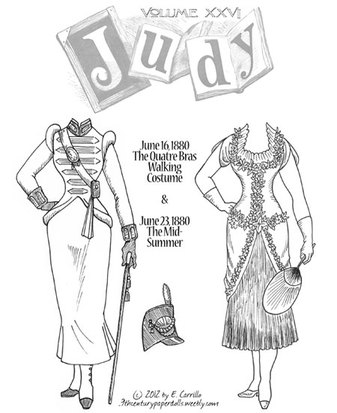
![]() This veiled mourning dress is from a round robin (how fun!) collection featured online by Klein. It seems like deep mourning of this kind was already beginning to fall out of fashion at the end of the century. The "modern" age had everyone looking forward, moving faster, and spending a year in black as a widow was a fading ritual in mainstream American culture. Too much sentimentality for the new era, perhaps. Advances in medicine, too, had made death a little less common (and therefore more morbid) than it had ever been. The idea of a paper doll round robin seems like such a cool thing. OPDAG features one every quarter in their Paper Doll Studio publication (for which, sadly, my subscription has lapsed). We should have a round robin online! ![]() Only one week in to my new schedule and I feel lamentably behind. But not for lack of working, I promise! In fact, I spent the lion's share of the weekend drawing so many dolls! Click on the image at the right to see the evidence with more clarity. I've really been struggling with my doll anatomy and proportions for a very long time. Generally when I draw people, they tend to be on the short and compact side. I have a bad habit of making their legs stubby and their torsos too big. I learned how to draw paper dolls from studying the massive body of work by Tom Tierney, learning especially how to handle hands and feet from his simple, effective linework. But I've always tried to avoid having my dolls look like his and in the end, the plain truth is that his proportions are pretty perfect and by avoiding scaling my dolls like his, I've basically been shooting myself in the foot. So I drew 11 dolls this weekend, based on his style (anatomy-wise and also mimicking his large "stand" for their feet). On the one hand, I look at these and think: geez, they look like copies because the poses are so similar (especially the women). That makes me cranky. On the other hand, they're kind of nice-looking, generally, and it's rare for me to be pleased enough with my dolls to actually follow through on them (in case you hadn't noticed). I'm going to continue working on these for the time being. Some of them need adjusting still (and a few I haven't decided arm positions just yet). And then next weekend I am hoping to go on a doll-making binge. And if you are still wondering when, oh when, am I ever going to get around to the clothing, I promise I have amassed a collection of reference materials the likes of which you cannot begin to imagine ~ and that once I am finally satisfied with the dolls there will be more clothes than you'll know what to do with! 2010 is my year of getting things done. Hang in there with me! Friday Fashion Plates: It's a live one! 02/05/2010
![]() Today's fashion plate series are, as of this date, currently for sale at Collector's Prints, going for a $39.99 a piece. This is a decent price for a 7x8 hand-colored plate of this age. The dresses are definitely 1830s-style, but the plates appear undated (I cannot read the tiny writing at the bottom to ascertain if they indicate which magazine these originally came from). The lack of information is a little unfortunate, but the images are very nice and the colors are bright. Gotta love those top-knots in the hairdos! ![]() The 1830s strikes me as a sort of ugly era for women's fashion: the hairstyles are complex and a little bizarre by modern standards and the sloping shoulders and pouf sleeves seem unflattering to me. I do love, however, the emphasis on teeny tiny feet (which seems more prevalent in this era than in subsequent ones, though women's feet will always be drawn like pointy little triangles throughout the century. The 1830s strike me particularly as having something of the ballerina implied in them, however. Tuesday Tabs: Napoleonic Uniform Dolls 02/02/2010
![]() First up from my collection is a paper doll book that doesn't exactly fit the model of this website (which focuses on the 1830s to 1900), but I had to share it anyway and will skate by on the assumption that these uniforms are from the 19th century and men's uniforms did not radically change in the 19th century until at least a quarter of the way in, by which point these designs (or parts of them at least) might be considered Victorian-era consistent. At any rate, this small book was a relatively recent acquisition off of eBay, published by Wolfe Publishing of London and part of their "Historical Dress-a-Doll-Series" that sold for 60p in 1975. I think what I love most about this format is twofold: it's a first-rate little piece of historical ephemera with short, but interesting notes about the 13 detailed dress uniforms featured (including French, British, Prussian, Spanish, etc.), but also the construction of the dolls themselves is so novel: with uniforms layered by each piece and including hats, guns, and other equipment. Let's face it, most paper dolls are designed for girls to play with and don't often include soldiers, so this is particularly exciting in that it not only includes soldiers (even a skull-topped "death squad"), but that it's designed in a unique way that lets you see the full complexity of some of these fancy old uniforms. Click on the image below to see one of the seven dolls in more detail. This company produced several other books, though a brief search has shown them difficult to find. There is one on Victorian Costumes that I would love to get my hands on if it even turns up in my travels. ![]() I'm running late, but determined to stay on schedule! For our first (and sadly brief) mourning post, I wanted to share with you one of Walter Plunkett's costume designs from Gone with the Wind, featuring the character of Scarlett O'Hara Hamilton dressed in deep mourning after the death of her first husband, Charles. While a number of the costumes constructed for the film production went off the rails in terms of historicality, the mourning dress worn by various characters throughout was generally very period-appropriate (which is good since Scarlett's flaunting the mourning attire is an important part of her character and the story). The image here (and click it to see it up close in all of its watercolor glory!) was found at Dial B for Blogger, a Spanish-language blog that features others of Plunkett's designs in a post honoring Gone with the Wind's 70th anniversary. Saturday Sartorial: More Morses, of course 01/30/2010
![]() I did not have time today, as I had planned, to dedicate exclusively toward my dolls, but I didn't want to start my first week of scheduled postings off on the wrong foot. So I share with you today something like proof that I'm actually working on these: a draft of the coats and hats for the Morse brothers. I do all of my drafting on old dot-matrix printer paper (you can see the little "feed" holes up top if you click to make the image bigger). I work out the designs in pencil over rough outlines of the characters. Then I use a lightbox to make sure the measurements are correct before transferring the designs to the actual watercolor paper for coloring. I'm actually considering doing these clothes on cardstock instead of water color paper since I will probably be coloring them with markers instead of paints. I'll probably make some changes on these before they are finished, including more specificity in the pattern on the vests, and adjustments to the lapels on the winter coat there. Not sure about the hat on Tennessee. I can't imagine him wearing a hat, though surely he must have one. I might change it to another style. I have some ideas, but I will reveal them later. Fashion Plate Friday! 01/29/2010
![]() Today's offering (the first of hopefully many Fashion Plate Fridays to come), is from Magasin des Demoiselles, February, 1859 and features some lovely children's fashions in addition to the more common adult subject. A number of my female characters are young girls in the 1850s, so I have been particularly looking for these kinds of examples. Children's clothes wouldn't become more practical under late in the century. For most of the era, girls dresses were simply miniature versions of what their mothers were wearing, with shorter skirts until age 14-18 (depending on the culture and social status of the family), when a girl was expected to come into society as marriageable young lady. I especially like the little blue booties on the older of the two girls here (probably dyed satin in this case). This plate was found at the immense and amazing Casey Fashion Plates Index, courtesy of the Los Angeles Public Library. Mozart says: try something new! 01/27/2010
![]() Happy Birthday Mozart! Inspired by the maestro, who did not live nor die in the Victorian era, but who accomplished so much well before he reached my age, I am attempting to get some kind of schedule going for this blog. I have decided to commit myself to updating on certain days of the week. This will insure that you get fabulous new content on a regular basis and that I will stay focused providing it! I think I have attempted to set a schedule before, but never posted it. In this way I will make myself accountable! So, starting on the 29th of January, I plan to adhere to the following schedule: Monday Mourning: fashions, ephemera, and other notions surrounding the intricacies of Victorian mourning (an art form all its own!) Tuesday Tabs: Victorian-styled paper dolls by other artists from my personal collection and others found around the web. Fashion Plate Friday: plates from the 1830s-1900 from my own collection and the many internet collections around the web. Saturday Sartorial: Original paper dolls and their clothes! A great new blog to peruse! 01/22/2010
![]() Check out: 19th Century Post: a mourning cover & miscellany collection. This website has a lot to offer! The miscellany part includes a great blog with a variety of interesting art & ephemera (including many painting and photographs of the fashions of the day), and the rest of the site is devoted to mourning covers (envelopes), which were an art form all their own in the 19th Century. You always knew it was bad news when you received a letter with black-trimmed edges or a black seal of wax. Click on the image at the left to see some details on this English example from 1872, then go browse the rest! What a beautiful (if somewhat sad) collection of letters... Meet the Morses ~ 01/16/2010
![]() I have been away a while, but as I promised, I have been working (slowly). I have been much encouraged by the comments I have received lately ~ it's always nice to know someone is reading the blog and following along and hoping for updates. It definitely motivates me to get back to updating! Today I am sharing with you a draft of three new dolls from the Morse family (from left to right): Ginny (short for Virginia), Tennessee (also called States), and Mish (short for Michigan). There are nine children in the Morse family, so for the moment six other sisters are absent (want to guess which states they are?). The Morses are the "ideal" Southern family of the era: wealthy, beautiful people who have literally been raised to "inherit the earth". Their father is a retired merchant sea captain who built a fortune in the slave trade and other "property" investments. But their world is far from ideal. Scarlet fever took their mother and blinded Ginny at a young age. Mish is a willful abolitionist zealot, and Tennessee...well, there's just something not quite right about him. And that's all the backstory you'll get from me for now. I'm working on their first outfits this weekend and will post a draft of those as well. Ultimately the downloadable/printable versions of these dolls will be featured along with the series when it kicks into gear hopefully in February! |


RSS Feed