19th Century Paper Dolls


Picture
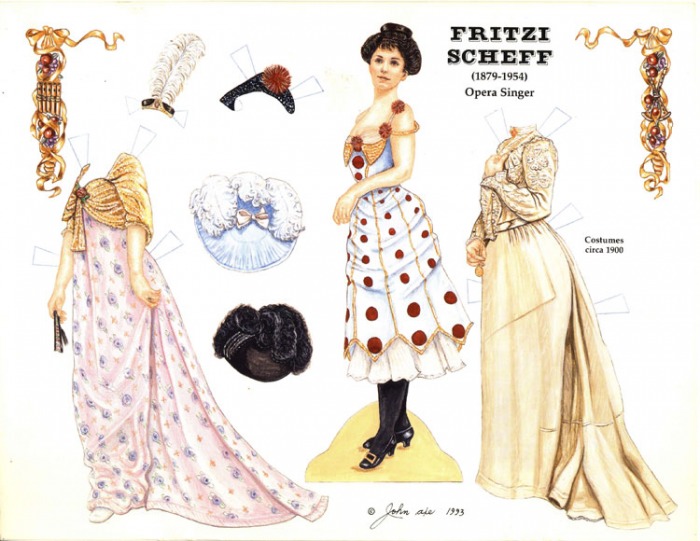
Fritzi Scheff was an American actress and singer who was popular in the early 20th century, though I have included her here because she was working by the turn of the century and her outfits are certainly reminiscent of the end of the Belle Epoque. This single page was done by John Axe and sports one of his nicer female dolls (click the image to see more details).

I admit I have not been working on my own 19th Century dolls for a while here as I reorganize my workspace and get things in order. But in case you missed it, I am regularly updating my other paper doll blog: Comic Book Chronicles.

I am hoping to post new stuff here soon enough, but in the mean time I hope you are enjoying seeing some of the stuff in my collection.


Picture
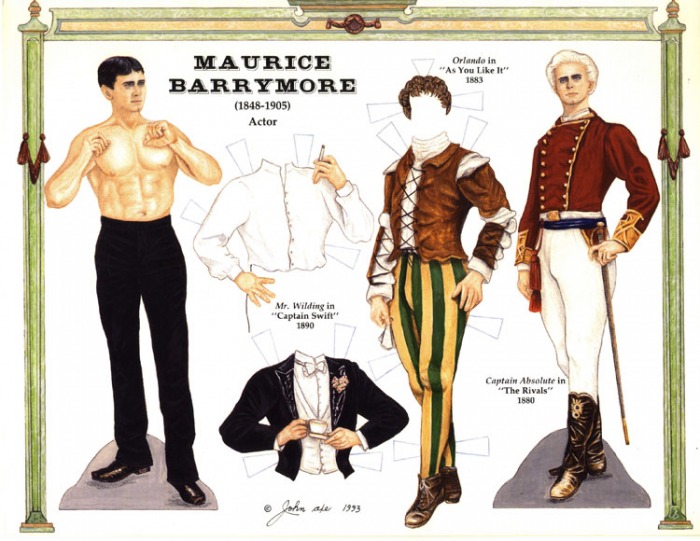
Maurice Barrymore was one of the great actors of the late 19th century (and the father of an acting dynasty that continues today).

19th century actors are a lot of fun because stage costumes back then were so fanciful (and often even ridiculous).

This is one of a handful of John Axe dolls I have in my collection. While I often enjoy Axe's subjects, his dolls are of mixed success for me. I think his faces in particular are not very attractive, unfortunately. In the case of this set of dolls, for example, the first one is good, but the second one looks a little strange, especially when you consider that Maurice Barrymore was quite handsome. Still, it's a nice small set and I enjoy having it as part of my collection.  Click on the image to see the art in much better detail!

Also, click here to see the original costume of "Orlando" represented above.


Picture
I am reminded that one of the reasons I began this blog was to sort of catalog the collection of paper dolls of the 19th Century that I have acquired over the years. I've been so distracted working on other stuff, I've hardly talked about the wonderful books available out there at all!

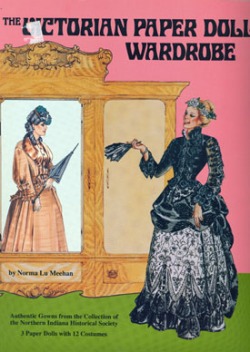
Today I offer a glimpse of Norma Lu Meehan's Victorian Paper Doll Wardrobe. I think this one is out of print, but you can find it on eBay and the like. Meehan's work is amazing on a lot of levels: she works from actual gowns from actual historical collections, which makes the amount of detail incredible. This particular set of dresses is from the Northern Indiana Historical Society.

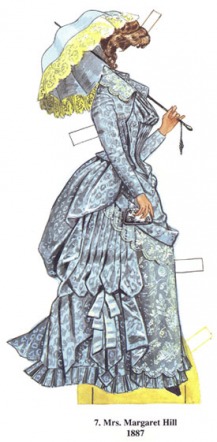
In the book there are three dolls and 12 dresses ranging from the 1860s to the 1890s (with an emphasis on the 90s ~ but a nice range of styles of that decade). The one I've posted here is from 1887 and was worn to a wedding reception (click the picture to see more details).

Picture
That's the other great thing about Meehan's books: the notes are fabulous, often telling who owned the dress, where it was worn (and why), and providing other detail about the type of material, accessories, etc.

Meehan has a number of books, all equally detailed (and just recently published a new book of 19th century wedding fashions ~ which I hope to acquire soon). I have several of her other books and will share reviews on them also.

And while I'm posting, I just want to say that I realize I am slow at posting new material of my own and hope to remedy that. On Halloween, I'll be launching a second blog with a project I have been working on (and which will be updating more quickly doll-wise that this one). Stay tuned!


Picture
I really have no excuse for not posting more work and more often here. It's not like making paper dolls is ever very far from my mind. Unfortunately, I have been so distracted with other things (like getting Reconstruction) up and running. I guess that's a good thing for my other website, but not so good for this poor neglected blog.

I am trying to turn a new leaf, however, and am committing myself to looking at the dolls I have waiting to dress and will be working on them this weekend. I'm not sure entirely what it will amount to, but I promise I will produce something just to get things rolling again.

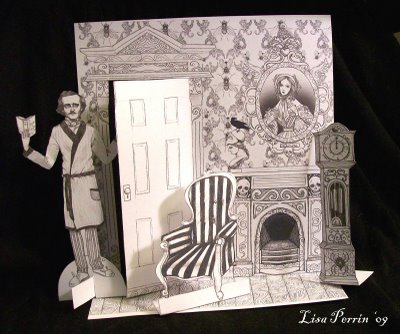
In the meantime, enjoy this Edgar Allen Poe cut out set from Lisa Perrin, who has such an interesting and delightful style. Poe's bunny slippers are not exactly period, but they're hilarious!There are other articulated paper dolls on her blog and a lot of other fun illustrations as well, many with a historical/antiquey bent. Beautiful and enviable work!

 
A 1860s doll 03/29/2009
 

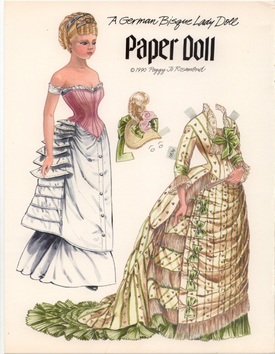
Today, though I am (and I promise) working on some dolls of my own, I wanted to share with you a lovely 1860s doll by artist Karen Reilly. She is a German bisque and originally appeared in the May 2008 issue of Doll Reader, but is now available as a free download from the Doll Reader web page.

I'm settling into the evening with my own work on my lap. It is entirely possible I might have something to share in the coming week.  I know, nobody hold their breath!


I thought I would take a moment to promote a couple of other sites out there that I really enjoy and that feature paper dolls in 19th century fashions. The first is Annas klippdocksblogg from artist Anna Forsén. The blog is in Swedish (which unfortunately I cannot read), but Google translator can give you at least a vague impression of what she's writing about. Still, you don't need it to enjoy her artwork! Anna creates mostly Regency-period dolls (19th century, right?), and they are wonderfully colorful (oh how I envy!). And she's incredibly prolific too (more to envy!). Click here to also see her website!

Her current project is  a wardrobe for her doll, Annissa. The dress here at right is my favorite of her recent additions. Click on it to see more details, as always.

The other site I want to share is Margaret's Fleming's My Paper Dolls. Fleming has many many dolls from a variety of inspirations, including ten sets of dolls from the 19th century (one set for each decade!).


Fleming's work is very nice and they are presented in .pdfs for ease of downloading if you want to play with them. Her period details are wonderful. My favorite are the dolls from the 1870s (click on the sample to the left). These dolls are all colored digitally and Fleming talks a little bit about her process on her website.

If you have dolls from the 19th century in a blog or website, post a comment with a link ~ I always enjoy seeing new work! And also, a quick thank you to Liana, my original inspiration, from whose blog I found these and many other exciting sources!


I'm always delighted to find paper dolls by artists other than Tom Tierney. Not that I don't appreciate Tierney's work (and especially since he's so prolific and has created so many cool 19th century-era dolls!). But I enjoy different styles and enjoy the distinctive qualities each artist brings to their own work.

I'm not very familiar with most of Stall's work, but I found this little gem (4 pages originally published in the May, June/July 1985 editions of Doll Reader) on eBay (where else?). I did not reproduce the whole set of costumes, but wanted to share the doll and my favorite dress at least.


This is Adrienne, a "fashionable lady of 1864" and her wardrobe is based on designs that originally appeared in The Lady's Friend, which was a journal for women produced in Philadelphia in the 19th century. The nice thing about Stall basing this on contemporary magazine fashions from the era is that she included some footnotes regarding the various pieces of clothing and where they originally appeared in the magazine. Very cool idea!

The Dress here at the left is my favorite of the lot and I am drawing something based on it for my own set of dolls (for Emmaline). You can see both the doll and the dress in much more detail if you click on the images.

Because this is printed on somewhat fragile magazine paper, I'm looking forward to making a photocopy on sturdy paper so that I can cut the pieces out. I love them so much in black and white, I don't think I'll even attempt to color them.


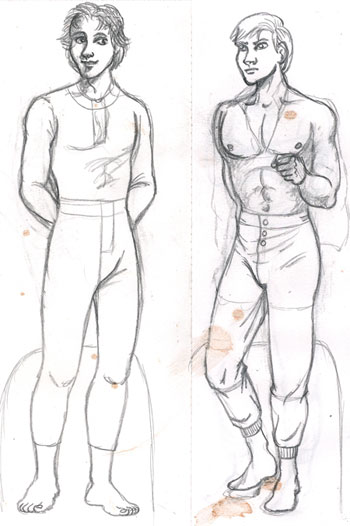
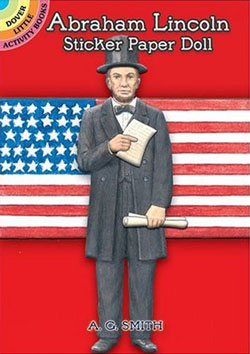
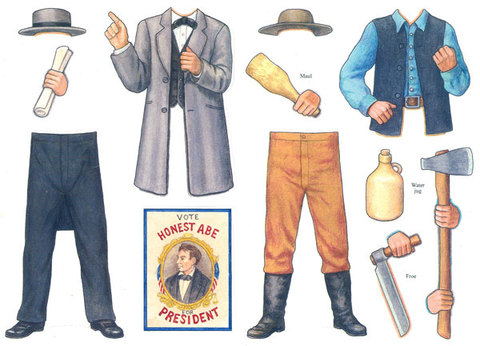
Robert Todd Lincoln gets the Tierney treatment in Abraham Lincoln and His Family. This has got to be one of the stranger set of paper dolls on some level: the Lincolns didn't exactly have a happy household; Lincoln was assassinated, Tad died young, and Robert and his mother parted ways rather bitterly over her erratic (insane) behavior. I'm surprised there's no inclusion of Willie among the boys (Why not? What's one more dead Lincoln?). Maybe it's just my own morbid mind that conjures these thoughts.

Otherwise, the collection is very nice (though I don't really need to think about what Abraham Lincoln looks like in his long johns). The inclusion of Mary's widows weeds brings us back to the whole "morbid" thing, but seems a necessary inclusion. With Tierney's other presidents, he often included some close friends or other "family", not so here. Just Abe, Mary, and the two boys. Probably that was a good choice. I don't know what I would have done if there had been a Stanton doll (shudder!).

I didn't get any work done on paper dolls last week (didn't like the way I mixed the paints and ended up with a flesh tone that was just gagly. So I ruined a set. Now I have to start over. I'll try to work on them this weekend and post something soon! I cleaned off my desk space so that I could work more comfortably, but of course it is already crowded with books and papers again.


There were a number of paper doll artists in the 19th century and a handful of them were famous (like Rafael Tuck), but it was refreshing to me to be introduced to a woman whose work was never published, who painted for the sole amusement of herself and her niece, and who left behind a wonderfully detailed extensive collection of paper doll families done in watercolor.

Anna Lindner was born in 1845. The image shown here was taken when she was about 18 years old. As a child, she contracted polio and was never able to walk. She taught herself painting and produced more than 600 pieces of work that have survived. A good deal more than half of these works were paper dolls, which she created for her niece Emilie, who apparently also suffered ill health.  The work sat in an attic for 50 years before it was dug up and donated to the New Jersey Historical Society.

Among the things I really cherish about her work is how she personalized the characters (you can imagine the stories she and Emilie shared about the families and their interactions). Also, she created families spanning more than 50 years, so all of the eras are represented throughout her work from the 1850s through the turn of the century.


Pretty impressive!  If that isn't enough, much of her work was double-sided, showing the fronts and backs of the clothing, and wonderfully detailed (shoes, accessories, hats, etc. ). She had a whole miniature little world of her own. On top of which I really love the vivid colors. After 100 years, these dolls look practically newly-painted!

You can see more pictures from the New Jersey Historical Society here. Also, read the American Heritage article about Anna Lindner here. The American Heritage article online unfortunately doesn't include the original pictures, but the two I have shared here come from that particular magazine.  Click on the image to the left to see a little more detail.


Since I returned from Costa Rica (hence my lack of updates since August), I have had many distractions. While the beach is conducive to relaxing and having fun, it's not so great for drawing, so I didn't get much done. Upon returning I had a number of other projects and family business to see to, and that has taken me away for the whole month of September! Now that I am back however, and more or less recovered from the travel (which always makes me lazy and stupid for a good while after), I am trying to get back to work. So I am forcing myself to update this blog.

Today's doll is by Peggy Jo Rosamund. Her dolls have always creeped me out because they are done in the style of old bisque and cloth dolls rather than "real people". They are rendered beautifully and the clothes are always exquisite, but those doll heads and joints just creep me out. Anyway, that didn't keep me from recently acquiring this small set representing Robert E. Lee and his wife done up as dolls circa 1860. The set includes uniforms from Lee's time in the Corp of Topographical Engineers (1839), with a lovely circa 1831 gown for Mary Custis; from Lee's time as Superintendent at West Point (1850s), which is the image shown; and during the Civil War.

It's a nice doll that I don't intend to cut. I also understand that Rosamund died earlier this year or last year (recently), so that makes it a nice keepsake.